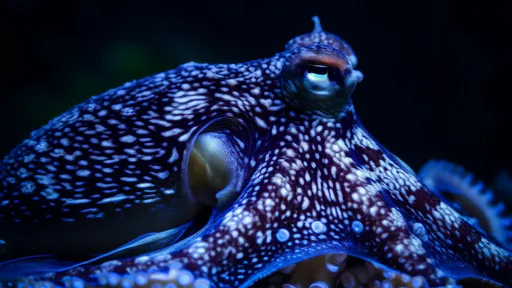
The ocean's most enigmatic communicators may not be dolphins or whales, but creatures with eight arms and color-changing skin. New research into cephalopod communication reveals that octopuses possess a sophisticated "skin syntax" system, where dynamic pigment cell combinations convey at least 30 distinct visual signals. This discovery fundamentally alters our understanding of invertebrate communication and challenges long-held assumptions about the complexity of nonverbal language in the animal kingdom.
Marine biologists at the Shoals Marine Laboratory have spent seven years documenting over 500 hours of octopus interactions in Caribbean reef ecosystems. Their high-resolution footage captured something extraordinary: what initially appeared as random color flashes actually followed consistent patterns. Each chromatic display functioned like words in a visual sentence, with specific pigment cell (chromatophore) combinations corresponding to distinct social messages. The common octopus (Octopus vulgaris) demonstrated particular sophistication, using its 3 million chromatophores like a living display screen.
Dr. Eleanor Marlow, lead researcher on the study, describes the system as "biological QR coding." Unlike human language with its linear structure, octopus signals operate in three-dimensional syntax - patterns evolve across the skin surface while changing color intensity and texture. One particularly complex display involved concentric circles of dark brown spreading from the eyes while the mantle turned pale with raised papillae. This "full alarm" signal immediately caused nearby octopuses to retreat into crevices, suggesting predators were approaching.
The research team identified six foundational "chromatophore morphemes" - basic color units that combine to create meaning. These include the uniform dark mantle (aggression), longitudinal stripes (courtship), and metachromatic waves (territorial warning). When these elements combine with skin texture changes (smooth, spiked, or wrinkled) and timing variables, the communicative possibilities multiply exponentially. Juvenile octopuses appear to learn these patterns through observation, with laboratory-raised individuals showing only 60% of the wild repertoire.
Perhaps most astonishing is the contextual flexibility observed. The same chromatic pattern can convey different meanings depending on body orientation and environmental factors. A "zebra stripe" display directed toward a competing male signals confrontation, while the same pattern aimed at a potential mate transforms into a courtship dance. This situational nuance rivals the complexity of human nonverbal cues like facial expressions.
Technological limitations previously obscured this communication system. Octopuses perceive polarized light and process visual information fundamentally differently than vertebrates. The research team developed multispectral imaging arrays capable of detecting wavelength variations invisible to human eyes. When analyzed through machine learning algorithms, what seemed like random color bursts revealed intricate combinatorial rules. The system's efficiency is remarkable - a complete "sentence" can transmit in 1.4 seconds through coordinated chromatophore activation.
This discovery has profound implications. If octopuses, which diverged from vertebrate evolutionary paths over 500 million years ago, developed complex visual syntax, it suggests that language-like systems may evolve more readily than previously believed. Marine biologists are now investigating whether squid and cuttlefish share similar capabilities. The military has shown interest in biomimetic applications, with DARPA funding research into adaptive camouflage based on chromatophore mechanics.
Yet mysteries remain. Researchers still don't understand how octopuses achieve such precise control over individual chromatophores without centralized neural processing. Each arm contains autonomous nerve centers, creating what Dr. Marlow calls "a distributed computing network." Some signals propagate across the skin at 20 cm/second - faster than neural transmission speed in these organisms. This suggests unknown electrochemical pathways may be involved in rapid pattern formation.
The ethical dimensions are equally compelling. Recognizing octopus communication complexity reignites debates about cephalopod cognition and welfare. With 30+ documented signals and likely more undiscovered, these creatures clearly engage in sophisticated social interactions. Aquarium protocols may need revision to prevent "visual pollution" that could disrupt their chromatic language. As we decode more of this skin syntax, we're not just studying octopus communication - we're learning to listen to an entirely new form of consciousness.
By /Aug 18, 2025
By /Aug 18, 2025

By /Aug 18, 2025
By /Aug 18, 2025
By /Aug 18, 2025

By /Aug 18, 2025

By /Aug 18, 2025
By /Aug 18, 2025

By /Aug 18, 2025
By /Aug 18, 2025

By /Aug 18, 2025

By /Aug 18, 2025

By /Aug 18, 2025

By /Aug 18, 2025
By /Aug 18, 2025
By /Aug 18, 2025

By /Aug 18, 2025
By /Aug 18, 2025
By /Aug 18, 2025

By /Aug 18, 2025
