The world’s coral reefs, often referred to as the "rainforests of the sea," are facing an existential crisis. Rising ocean temperatures, acidification, and pollution have pushed these delicate ecosystems to the brink of collapse. In a race against time, scientists are exploring unconventional methods to safeguard coral biodiversity. One such groundbreaking initiative is the Coral Cryo-Ark—a project that aims to freeze coral larvae at -196°C and revive them in the future, offering a lifeline for species on the edge of extinction.
The concept of cryopreservation is not new. For decades, researchers have successfully frozen and thawed sperm, eggs, and embryos of various species, from livestock to endangered mammals. However, applying this technique to coral larvae presents unique challenges. Coral larvae are far more complex than single cells or small clusters, and their survival after freezing requires precise scientific intervention. The Coral Cryo-Ark project, spearheaded by marine biologists and cryogenics experts, seeks to perfect this process, ensuring that coral species can be preserved and eventually reintroduced into the wild.
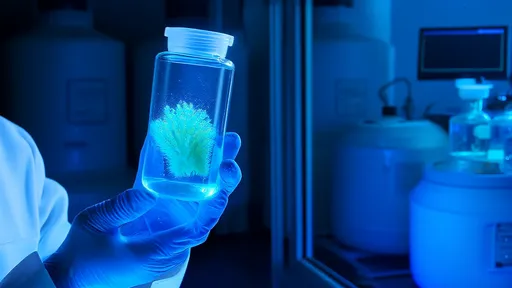
The process begins with the collection of coral spawn during natural reproductive events. Corals typically release their eggs and sperm in synchronized mass spawnings, which occur only a few times a year. Scientists must carefully time their expeditions to capture these fleeting moments. Once collected, the larvae are subjected to a series of cryoprotectant treatments—chemical solutions that prevent ice crystal formation, which would otherwise rupture cell membranes. The larvae are then slowly cooled to sub-zero temperatures before being plunged into liquid nitrogen, where they remain in suspended animation at -196°C.
Reviving these frozen larvae is an equally intricate process. Thawing must be rapid to minimize damage, and the larvae must be gradually reintroduced to seawater to avoid osmotic shock. Early experiments have shown promise, with some coral larvae surviving the freeze-thaw cycle and even settling onto substrates to begin new colonies. However, the success rate remains low, and researchers are continuously refining protocols to improve viability. The ultimate goal is to create a global coral seed bank, where genetically diverse coral specimens can be stored indefinitely and deployed for reef restoration when conditions improve.
The ethical and ecological implications of this project are profound. Critics argue that cryopreservation should not divert attention from addressing the root causes of reef decline, such as climate change and coastal development. Yet proponents counter that the Coral Cryo-Ark is a necessary insurance policy—a way to buy time for coral species while global efforts to reduce carbon emissions and protect marine habitats gain traction. Without such interventions, they warn, many coral species could vanish before solutions are implemented.
Beyond its scientific ambitions, the project also highlights the urgent need for international collaboration. Coral reefs span the globe, and their decline affects not just marine life but also the millions of people who rely on them for food, tourism, and coastal protection. The Coral Cryo-Ark initiative has already drawn support from research institutions, governments, and conservation organizations worldwide. By pooling resources and expertise, these stakeholders hope to create a robust framework for coral preservation that can be scaled up in the coming years.
Looking ahead, the team behind the Coral Cryo-Ark envisions a future where frozen coral larvae can be thawed and reintroduced into rehabilitated reef systems. Advances in cryobiology, coupled with emerging technologies like assisted evolution and 3D-printed coral structures, could one day enable the full restoration of degraded reefs. While the road ahead is fraught with challenges, the project represents a beacon of hope—a testament to human ingenuity in the face of ecological crisis.
For now, the work continues in laboratories and reef sites around the world. Each successful freeze-thaw cycle brings scientists one step closer to their goal. And as the oceans warm and reefs bleach, the importance of this mission only grows clearer. The Coral Cryo-Ark may not be a silver bullet, but it is a vital tool in the fight to save one of Earth’s most vital ecosystems—one frozen larva at a time.
By /Aug 18, 2025
By /Aug 18, 2025

By /Aug 18, 2025
By /Aug 18, 2025

By /Aug 18, 2025

By /Aug 18, 2025
By /Aug 18, 2025
By /Aug 18, 2025

By /Aug 18, 2025
By /Aug 18, 2025
By /Aug 18, 2025
By /Aug 18, 2025

By /Aug 18, 2025

By /Aug 18, 2025
By /Aug 18, 2025
By /Aug 18, 2025
By /Aug 18, 2025
By /Aug 18, 2025
By /Aug 18, 2025

By /Aug 18, 2025
