In the intricate world of honeybee communication, few phenomena are as fascinating as the waggle dance. This complex form of symbolic language allows scout bees to convey precise information about the location of food sources to their hive mates. Recent research has uncovered remarkable mathematical sophistication in how bees encode distance and direction in their movements, revealing what scientists now call "dance mathematics."
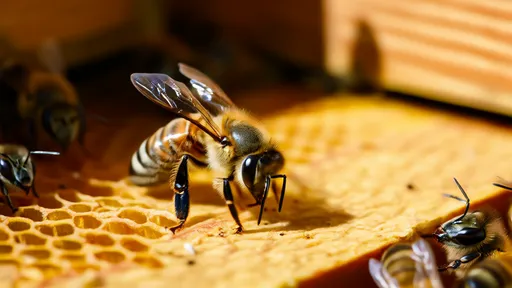
The waggle dance is performed by scout bees upon returning from a successful foraging trip. As the bee moves in a figure-eight pattern, it waggles its abdomen during the central straight portion of the dance. The duration of these waggles corresponds to the distance of the food source, while the angle of the straight run relative to gravity indicates direction relative to the sun. What appears as simple instinctual behavior actually involves sophisticated vector calculations performed by tiny insect brains.
Decoding the waggle dance's mathematical precision has become a major focus of animal behavior research. Studies using high-speed cameras and motion tracking software have shown that honeybees adjust their dance movements with remarkable consistency based on flight distance. For every 100 meters flown to a food source, the bee adds approximately 75 milliseconds of waggle duration. This linear relationship holds true across different environments and bee species.
The directional component of the dance demonstrates even more sophisticated processing. Bees must constantly recalculate the sun's position relative to their flight path and translate this three-dimensional information into a two-dimensional vertical display in the dark hive. This requires continuous adjustment for both the sun's movement across the sky and the changing angle of the bee's approach to the food source. The precision with which they maintain this angle—often within 2-3 degrees of accuracy—suggests an innate understanding of vector mathematics.
Neuroscientific investigations have begun uncovering how bee brains process this spatial information. The mushroom bodies, regions of the insect brain associated with learning and memory, show increased neural activity during both foraging flights and dance performances. Researchers believe these structures may function as biological calculators, integrating visual flow (the apparent motion of objects during flight) with time measurements to compute distance, while processing polarized light patterns to determine direction.
The implications of bee dance mathematics extend beyond entomology. Robotics engineers are studying these behaviors to develop more efficient swarm navigation algorithms. The bees' ability to perform complex vector calculations with minimal neural circuitry offers inspiration for designing lightweight, energy-efficient autonomous systems. Some researchers suggest that understanding how bees collectively process spatial information through dance could lead to breakthroughs in distributed computing architectures.
As climate change alters flowering patterns and habitat availability, the precision of bee communication becomes increasingly crucial for colony survival. The mathematical elegance of the waggle dance represents millions of years of evolutionary refinement—a testament to nature's ability to encode complex information in seemingly simple behaviors. Continued study of this phenomenon promises not only to deepen our understanding of animal cognition but may also provide solutions to human technological challenges.
By /Aug 18, 2025

By /Aug 18, 2025

By /Aug 18, 2025

By /Aug 18, 2025

By /Aug 18, 2025

By /Aug 18, 2025

By /Aug 18, 2025

By /Aug 18, 2025

By /Aug 18, 2025
By /Aug 18, 2025

By /Aug 18, 2025

By /Aug 18, 2025

By /Aug 18, 2025

By /Aug 18, 2025

By /Aug 18, 2025

By /Aug 18, 2025

By /Aug 18, 2025

By /Aug 18, 2025

By /Aug 18, 2025

By /Aug 18, 2025
